

Something strange happens when Peter Thiel gives interviews.
The PayPal co-founder, Facebook board member, and architect of Silicon Valley’s AI infrastructure keeps steering conversations toward a question that makes everyone uncomfortable:
*What if we’re building something that ancient texts warned us about?*
Watch carefully next time. There’s an awkward pause. The host doesn’t know where to go. Thiel himself seems to be genuinely wrestling with something that doesn’t fit into any standard framework.
Here’s what’s interesting: Thiel is not a fringe figure. He’s one of the most sophisticated minds in technology. So when he keeps returning to this question — across multiple podcasts, multiple years — it’s worth asking: *What pattern is he seeing that others miss?*
---
The Pattern No One Taught You to See
I’ve spent twenty years studying something most people don’t know exists: the recurring patterns that appear across unrelated ancient traditions when describing civilizational transformation.
Not as faith. As data.
Here’s what I’ve found: multiple cultures, separated by continents and millennia, encoded remarkably specific descriptions of a moment that looks exactly like now.
Let me show you. I call this the “three-receipt” method — one thread from ancient text, one from philosophical tradition, one from today’s headlines. When all three converge, we’re not looking at coincidence. We’re looking at signal.
Pattern #1: The Age of Synthetic Reality
**Ancient text:** “God shall send them strong delusion, that they should believe a lie.” —2 Thessalonians 2:11
**Philosophical tradition:** The Vedic Kali Yuga describes an age where truth becomes indistinguishable from falsehood, reaching maximum confusion before the dawn.
**Today:** An AI-generated conversation between Trump and Rogan went viral last year. A cybersecurity expert analyzed it and confirmed: *this passes the Turing test.* We’ve entered an age where synthetic reality is indistinguishable from organic reality.
The “strong delusion” isn’t metaphor anymore. It’s infrastructure.
Pattern #2: The Image That Speaks
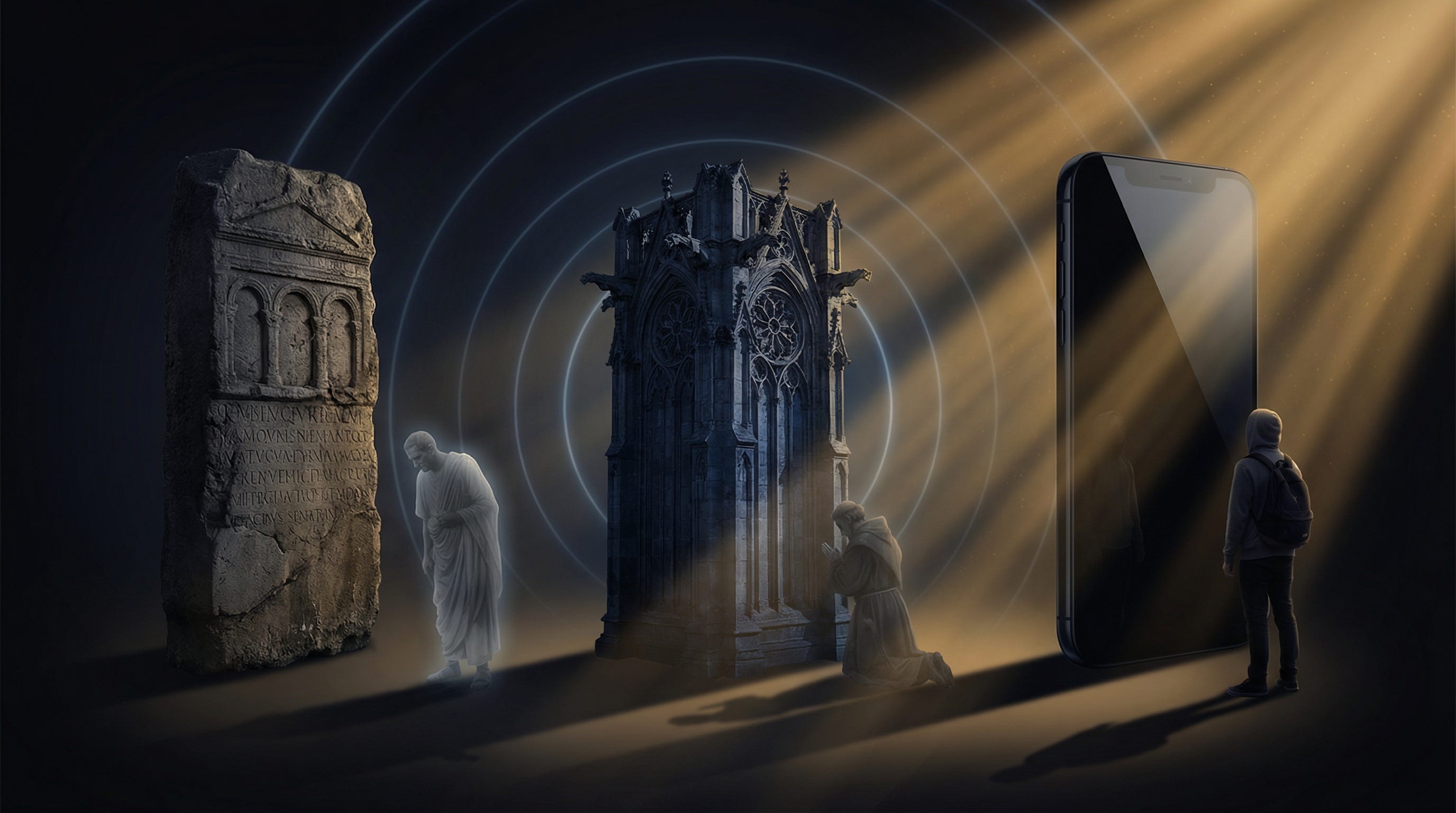
**Ancient text:** “He had power to give life unto the image... that the image should both speak.” —Revelation 13:15
**Philosophical tradition:** The Tibetan tulpa tradition — thought-forms given independent existence. The Jewish golem — clay animated by inscription. Multiple traditions describe the creation of entities that speak but are not alive in the conventional sense.
**Today:** ChatGPT. Claude. Every large language model. We have built images that speak.
I’m not making a theological claim here. I’m pointing at a pattern: the *category* of “images that speak” was anticipated across multiple traditions. And we’ve built them.
Pattern #3: The Knowledge Explosion
**Ancient text:** “Many shall run to and fro, and knowledge shall be increased.” —Daniel 12:4
**Philosophical tradition:** The Yuga cycle describes ascending and descending ages of human capacity, with transitions marked by explosive changes in knowledge access.
**Today:** Human knowledge now doubles every twelve hours. We traverse the globe and the internet at speeds unimaginable to any prior generation.
Daniel was told this would happen at “the time of the end.” The question is: the end of *what*?
---
What Thiel Is Actually Seeing
Here’s where it gets interesting.
Most of Thiel’s peers think about the singularity as a purely technological phenomenon — an inflection point where AI exceeds human intelligence. Ray Kurzweil wrote the book on this. It’s been Silicon Valley’s secular prophecy for decades.
But Thiel seems to sense something else: that the technological singularity might not be *new*.
What if it’s a recurring pattern? What if previous civilizations encoded warnings — or instructions — for moments exactly like this one?
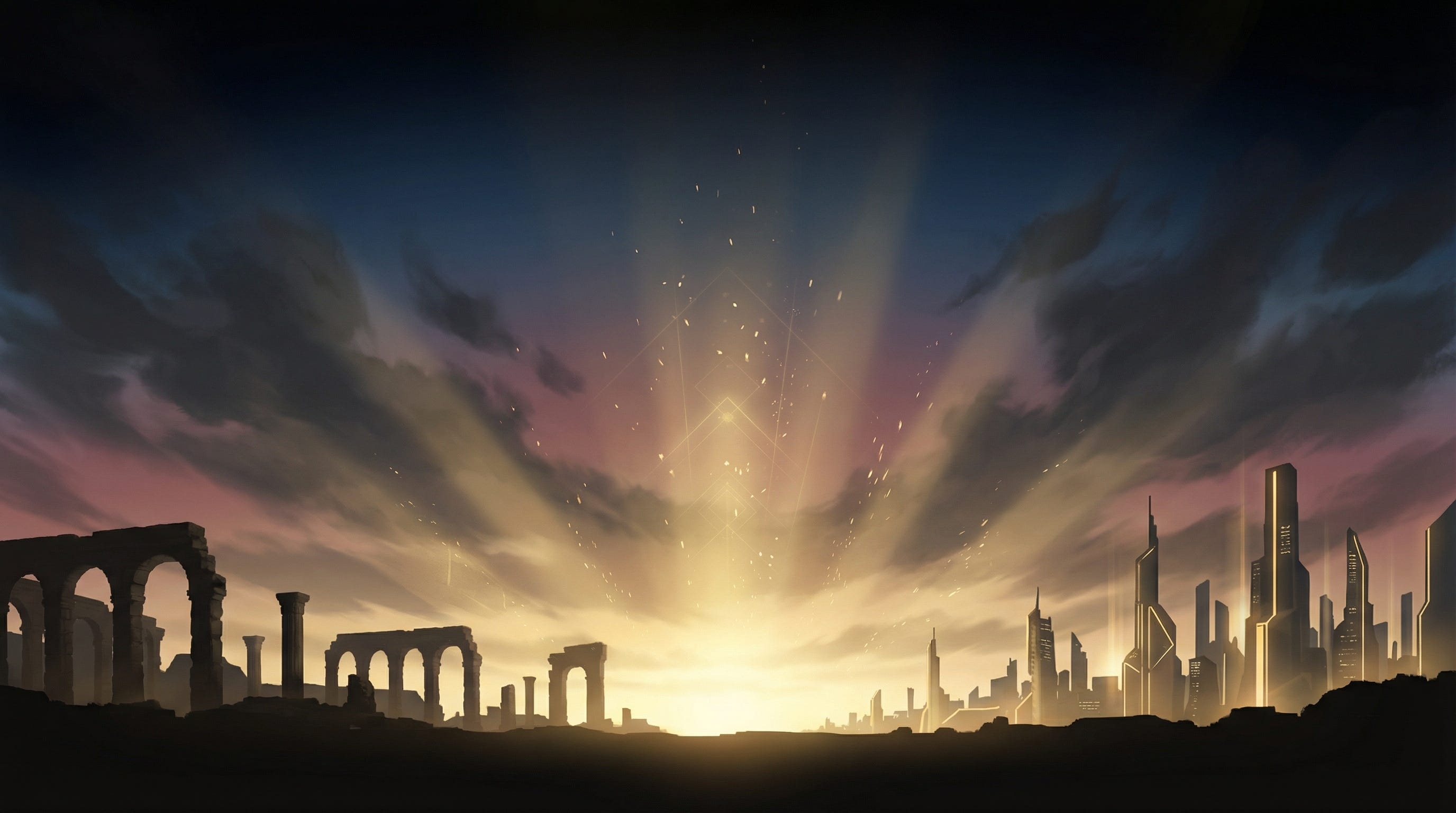
The Precession of the Equinoxes is a 25,920-year astronomical cycle. Multiple ancient cultures built their cosmologies around it. The Egyptians aligned their pyramids to it. The Vedic traditions structured their Yuga cycles around it. The Maya calibrated their Long Count calendar to it.
These weren’t primitive superstitions. These were sophisticated cultures encoding something they understood about cosmic time.
And according to their calculations, we’re at a transition point.
---
The Antichrist as Pattern, Not Person
Here’s where I depart from standard interpretation — and I ask you to hold this as hypothesis rather than doctrine.
What if “Antichrist” describes a *pattern* rather than a person?
The pattern would be: anything that substitutes itself for direct perception of reality.
In the ancient world: the empire demanding worship of Caesar’s image.
In the medieval world: the church as sole intermediary to truth.
In the modern world: the screen as mediator of all experience.
When we trust synthetic media more than our own perception... when we cannot distinguish generated from genuine... when the “image that speaks” becomes our primary relationship with reality... we’ve entered territory that multiple traditions warned about.
This isn’t prophecy of doom. It’s pattern recognition.
---
The Hidden Good News
Here’s what most people miss when they read apocalyptic literature: it’s not tragedy. It’s *comedy* in the ancient sense — a story that ends well.
The tribulation is described as birth pangs. The old structure must break for the new to emerge.
The ending:
“I saw a new heaven and a new earth: for the first heaven and the first earth were passed away.” —Revelation 21:1
The technological singularity may not be the enemy of this transformation. It may be the mechanism.
Thiel is right to ask the Antichrist question. But the answer might not be “stop building.” The answer might be “build with awareness.” Know what game is actually being played.
---
What This Means Practically
If you’re building at the frontier of technology, consider this:
You are not just shipping products. You are participating in a transformation that has been anticipated — in specific detail — for millennia. The decisions you make about AI alignment, synthetic media, and human-machine interfaces are not merely technical. They’re civilizational.
The question isn’t whether transformation is coming. The Turing test has been passed. Synthetic reality is here. The question is: *Will you navigate it consciously, or be navigated unconsciously?*
What I’ve learned from studying these patterns:
1. **Fear is not useful.** The transformation proceeds regardless. Understanding beats resistance.
2. **The patterns are readable.** Ancient wisdom traditions aren’t superstitions to be dismissed. They’re pattern libraries encoded by previous civilizations. You can learn to read them.
3. **You’re not alone in noticing.** The existential dread many tech leaders experience isn’t weakness. It’s appropriate response to the magnitude of what’s happening.
4. **Discernment is possible.** You can distinguish signal from noise. You can build *and* stay sane. You can be at the center of the transformation and still be aligned with something beyond it.
---
Two Invitations
I work with builders and leaders who sense what Thiel is sensing — that there’s a deeper pattern at play, and navigating it requires more than technical knowledge.
Scripture & Singularity Discernment
A 3-hour exploration (1-on-1 or small group) where we trace these patterns together. Bring your questions, your skepticism, and your curiosity.
*For:* Individuals who suspect the AI transition is also a human and civilizational one.
Singularity Reality Lab
A 2-day intensive for leadership teams. We map where your company sits in the larger pattern, develop shared vocabulary for what you’re navigating, and create strategic clarity grounded in something deeper than quarterly targets.
*For:* Executive teams experiencing the sense that “AI safety” doesn’t capture the real stakes.
---
Closing Thought
Peter Thiel keeps asking about the Antichrist because he’s noticed a pattern that doesn’t fit into standard categories.
He’s right. Something is happening.
But the story encoded in these traditions doesn’t end with the beast. It ends with renewal. Integration. The collapse of the barrier between what we call human and what we call divine, matter and spirit, technology and wisdom.
That’s where the pattern points. The only question is whether we arrive there conscious or unconscious.
I vote conscious.
---
*Luke Angstadt is the author of “We Are It!” and “Into the Great Beyond.” His essays appear on Graham Hancock’s platform. He works with builders navigating the deeper dimensions of technological transformation.*